Now that we are starting to use the front of the church more, it seems that this is good time to notice what is growing in the meditation garden.
We have missed a few flowers:
Golden Grounsel
These plants were flowering on April 25.
And before that there were Virginia Bluebells:
Virginia Bluebells
The flowers we are going to see next are called whorled coreopsis or threadleaf coreopsis.
Here is what Plant NoVa Natives has to say about them:
Coreopsis verticillata
Category: Perennial
Height: 1 to 3 feet
Season: Late spring
Soil: Loam
Deer : Usually resistant to deer browse
Wildlife : Bees. Adult butterflies or moths.
Moisture: Dry
Sun Needs: Full or Part Sun
Design Function: Border. Containers.
Gardening Tips: .5-3.5 feet. Moonbeam cultivar is sterile (will not self seed) and is very long-blooming. Nice mounded shape when mature. Spreads slowly by rhizomes. Spreads sideways. Tolerates drought. Blooms all summer, yellow flowers. Downy mildew. Shear in August to promote rebloom in September (not necessary for first year plants which will bloom all season.)
Have you noticed the lovely red berries on some new shrubs next to the upper parking lot? The plant is called Winterberry, and here is some information about it:
Blooms: April – May
Berries: September – November (Red berry on female plant only)
Height: 3 – 10 feet, globular
Light: Full sun to full shade (That’s a pretty versatile plant!)
Leaves are not shaped with sharp teeth like other hollies and are not evergreen
Need male and female plants to produce fruit. (We have both – you can easily identify the females – they have the berries.)
The berries are quite showy and will persist throughout the winter and often into early spring, providing considerable impact and interest to the winter landscape.
Special value to honeybees
Attracts butterflies and birds (food, cover and nesting)
Larval host to Henry’s Elfin butterfly, which looks like this:
Let us know in the comments when you have seen the winterberry plants.
The Jesus Movement is the ongoing community of people whose lives are centered on Jesus of Nazareth. We follow him into loving, liberating, life-giving relationship with God, with each other and with Creation.
As a whole church, we have promised to place the care of God’s Creation at the heart of our common life. Together, we have taken up church-wide action in order to safeguard the integrity of Creation and to sustain and renew the life of the Earth.
Below are goals and a vision for Care of Creation, developed by the Presiding Bishop’s Office and leaders of the Advisory Council on Stewardship of Creation and in alignment with actions by the 79th General Convention. Search for the resolutions at www.generalconvention.org/legislative-information-gc2018
Loving – Goal #1
Create and sustain a network of Episcopalians dedicated to the care and protection of the whole Creation, especially by providing grants and cultivation circles for Story Sharing among practitioners in local and regional ministries
Introduce new staff position with special attention to Care of Creation
Continue Care of Creation Grants program
Facilitate development of networks of practitioners, by state and / or affinity
Link with StorySharing work like Beloved Community StorySharing Project, Called to Transformation, and Climate Reality to share stories of our love for God and Creation
Liberating – Goal #2
Stand in solidarity with the most vulnerable victims of the impact of climage change – particularly women, poor people, and people of color – as part of seeking the liberation and flourishing of all God’s people.
Develop 2 – 3 eco-justice sites where the church invests significant energy and resources
Oppose environmental racism, sexism, classism
Support advocacy and governmental engagement via the Office of Governmental Relations, the Episcopal Public Policy Network, and participation in the United Nations Framework Convention on Climate Change, Conference of Parties
Advocate to protect vulnerable people / lands/ species, especially in the Arctic Wildlife Refuge
Inhibit exploitative extraction practices
Life-Giving – Goal #3
Set climate mitigation benchmarks as individuals and as a church, in order to live more simply, humbly, and gently on the Earth.
Develop, curate and distribute formation resources to support Episcopalians who wish to commit to simple, humble, gentle living on the Earth
Support use of the carbon tracker
Promote conscious food decisions and local, sustainable agriculture
Support use of the carbon tax and carbon offsets
Ask diocesan officials to track energy use as part of the parochial report, and promote energy and water efficiency across the church
Adopt the Paris Accord at state, regional and local levels
Work toward regenerative agriculture, biodiversity conservation, and habitat restoration
Help communities to transition to clean energy economies and encourage stewardship of creation with church owned lands
Promote ocean health and phase out use of bottled water in church-related facilities
Incentivize renewable energy and track fossil fuel divestment / reinvestment
Contact: The Rev. Melanie Mullen Director, Reconciliation, Justice and Creation Care
Rebecca Blachly Director of Government Relations, Episcopal Public Policy Network, Environmental Concerns
I learned relatively recently that there are about 4000 species of bees that are native to North America, and honey bees are not one of them!
Most of our bees are solitary, meaning that each bee is responsible for laying her own eggs, and tending her own nest. That means that there is no queen to defend, and therefore no incentive to sting.
Solitary bees don’t make honey, but they are particularly good at pollination. So there’s that trade-off.
Mason bees hatch in the spring. They feed on the nectar of the blossoms that are flowering then, for example the redbud trees that are found here in Virginia. And, incidentally they are pollinating as they go – giving us tree fruits, like cherries and apples.
They lay their eggs, future females first, then males, in the hollow tubes formed by the dried stems of last years plants. The bee lays an egg, places a nutritious pollen loaf next to it, and the seals it up with mud. Building with mud gives them the name “mason” bees. Then she lays another egg, includes some pollen, and seals it in, continuing along the length of the tube.
Fueled by the warmth of summer, the eggs hatch, the larvae eat the picnic their mother left for them, and when they are big enough, they make their cocoons, right there inside the tube.
Then, when the weather gets cooler – they hibernate for the winter. Warm spring weather tells them it is time to hatch. Males emerge first, so they’re ready to greet the females as they appear.
And then off they go to begin feeding and pollinating.
For more information about these fascinating creatures, visit the Crown Bees website.
And if you think this is just the coolest thing ever, then let us know in the comments section.
Before we get to the nurseries, I have just found out about how to get free tree seedlings. Here’s what to do:
ReLeaf Fall 2019 – Seedlings Available The plants will be dug up mid-October to November. All requests distributed in the order received. They are all bare root saplings.
Arrowwood Viburnum
Buttonbush (Cephalanthus occidentalis) to replace the invasive buddleia bush
River Birch (Betula nigra) fairly safe from white-tailed deer
Black Cherry (Prunus serotina) fairly safe from white-tailed deer
Bald Cypress
Beech (fagus)
Flowering Dogwood (Cornus florida)
Gray Dogwood (Cornus racemosa)
Silky Dogwood(Cornus amomum)
Washington Hawthrorn
Hazelnut (corylus)
Hornbeam
Sugar Maple (Acer saccharum) fairly safe from white-tailed deer
Oak: (quercus) Black, Chestnut, Northern Red, Pin, Southern Red, White
Willow
Pawpaw
Persimmon
Loblolly Pine
American Plum (Prunus americana)
Redbud
Sycamore
Winterberry Holly
To place an order contact trees@fairfaxreleaf.org and state the species and quantity requested. You will receive an email when your order is ready. Pick up is at Potomac Vegetable Farms, which is near the intersection of Beaulah Rd and Route 7. Fairfax Re-leaf has a nursery there.
And now, back to our regularly scheduled program: Most nurseries sell plants that are native to northern Virginia as well as those that are not. In our area there are two nurseries that specialize in native plants.
One of these nurseries is called Nature by Design. This is what they say about themselves:
We offer an outstanding range of native trees, shrubs, perennials, and annuals, including many unavailable elsewhere in the Washington area. Our innovative approach to landscape design will:
Reduce maintenance
Protect our precious Chesapeake Bay watershed
Replace vanishing wildlife habitat
Transform your yard into a sanctuary of breathtaking beauty
Their address is: 300 Calvert Avenue, Alexandria, VA 22301. And here is a link to their website: http://www.nature-by-design.com/
The other local nursery is called Watermark Woods. Their address is: 16764 Hamilton Station Rd, Hamilton, VA 20158. Phone 540-441-7443. Here is a link to their website: https://www.watermarkwoods.com/
If you know of any other nurseries that specialize in native plants, please let us know in the comments.
Monarch butterflies cover every inch of a tree in Sierra Chincua.
Each different butterfly species has its own strategy for dealing with the cold. Monarchs survive the winter by migrating.
Monarch butterflies spend the winter in Mexico. In the course of a year, including a few generations, monarchs travel between Mexico and Canada and back. (And I thought I had a long commute!) To learn more about this migration, click here
Some butterflies remain in egg form for the duration of winter. For example, the red-banded hairstreaks lay their eggs on fallen oak leaves. That is convenient, because the first food this newly-hatched caterpillar needs, is oak leaves! Here is a picture of an adult:
Red-banded hairstreak
Some species’ eggs have already hatched by the time the weather gets cold. These caterpillars snuggle down under a layer of fallen leaves and wait it out. Here’s a picture of wooly bear caterpillar in its winter coat:
Wooly bear caterpillar ready for winter
If a caterpillar has already formed its cocoon, it can spend the winter in that form. So as to blend right in, some species disguise themselves as dry leaves, like this swallowtail chrysalis.
Swallowtail chrysalis
That is a bit of a risky strategy because it might get gathered up with the rest of the fall leaves and shredded.
Who knew there was so much life in our dead leaves? To protect these beneficial creatures, we might consider clearing some of the leaves on our properties, but not all. For example, turf grass doesn’t support much butterfly life, so clearing our lawns would probably disturb overwintering butterflies the least. Allowing the leaves to remain around those flowering plants that attracted butterflies would probably help the most.
The Meditation Garden starting to be covered by fallen leaves
For more information, follow this link to read about the xerces society “Leave the Leaves” suggestions.
One of the wonderful things about plants is that they multiply themselves. A few plants together will sometimes grow into a dense mass. When that happens, it is often helpful to thin out the plants, so that each has enough light and space to grow.
What, then, do we do with the plants we don’t need? Why, give them away of course!
People with extra Northern Virginia native plants are planning to bring them to church on Sunday September 29. They will have them on a table outside the main door of the church – right next to the new Meditation Garden. And, if you feel inclined to experiment with a new kind of plant – then take one home, and put it in the ground.
If you have plants to share, then please bring them to church with on that day. However, they do need to be native to Northern Virginia. If you’re not sure then go to Plant NoVa Natives, and check their guide.
It would help if you would let us know in the comments section if you are planning to bring plants. But if you prefer, you can still surprise us!
Bonus: Learn how to Create a Butterfly Garden in Five Easy Steps here
Does anyone remember a book called The Very Hungry Caterpillar by Eric Carle? The caterpillar was so hungry it ate a different kind of fruit every day. Then it eventually spun a cocoon and, on the last page, emerged as a butterfly. Hooray!
Well, I’m sorry to have to break it to you, but that book is not scientifically accurate. I know, it came as a surprise to me too. The fascinating thing about caterpillars is that each kind can only eat the leaves of a very few plants.
Sometimes, in fact, of only one kind of plant. They are not just being picky eaters – they really cannot get nourishment from any other plant. So each caterpillar has a particular host plant, which it can eat.
One thing that the book did get right is that if you want butterflies, you have to start with caterpillars. And if you want caterpillars, then you have to grow the kinds of plants they can eat.
You would think, then, that each butterfly would be associated with a particular plant. That would be kind of neat and tidy, wouldn’t it? But no, life is far more complicated than that.
Caterpillars, of course, come from eggs. The eggs have to be laid on or near the leaves of the host plant. But the eggs are laid by an adult butterfly, who has to be eating to stay alive. And who is to say that the host plant will be in flower at this time, or even that the host plant has flowers that make suitable food for butterflies? And even if a flower has suitable food, it has be the right shape – a butterfly cannot get nectar from a tubular flower like a honeysuckle. The butterfly would feel like a lady in a crinoline dress, just unable to get her wings through the narrow doorway.
So, armed with these fascinating facts, how does one set about making a butterfly garden?
Well, either you can start from the butterfly end, and ask if I want this kind of butterfly, what plants does it need? Or you can start from the plant end, and say what kind of butterfly will this sort of plant attract and support?
Personally, I go for choosing the plants first, because that’s more motivating. If you set your heart on a particular butterfly, and plant to attract it, it will be disappointing if that butterfly does not show up. Whereas if you put in plants that you like, you can enjoy them anyway. And if, surprise! a butterfly shows up, well, isn’t that wonderful.
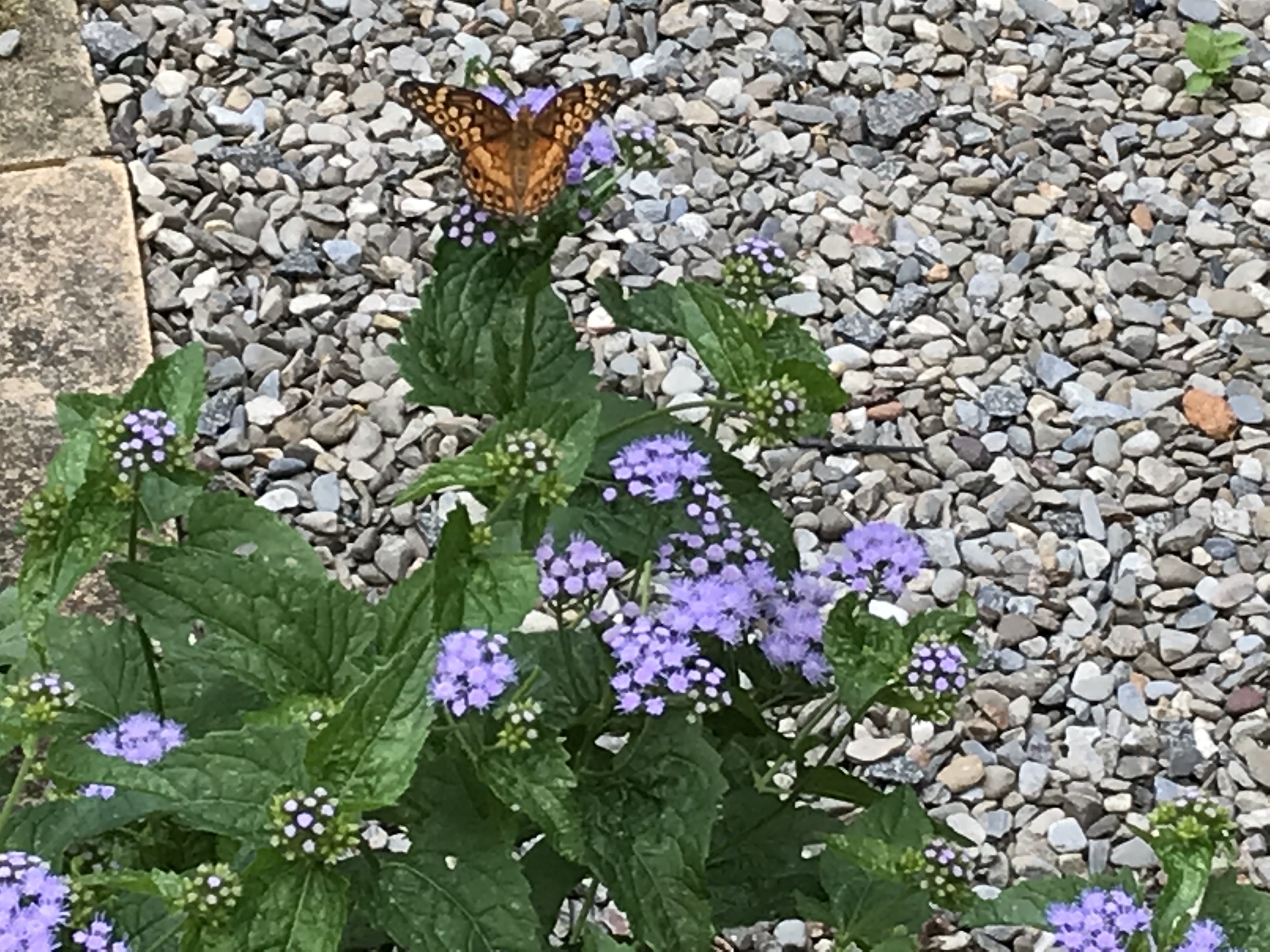
I saw a butterfly in the Meditation Garden today. It was orange, but it moved too fast for me to see what it was. Tell us in the comments section if you have seen a butterfly on church property.
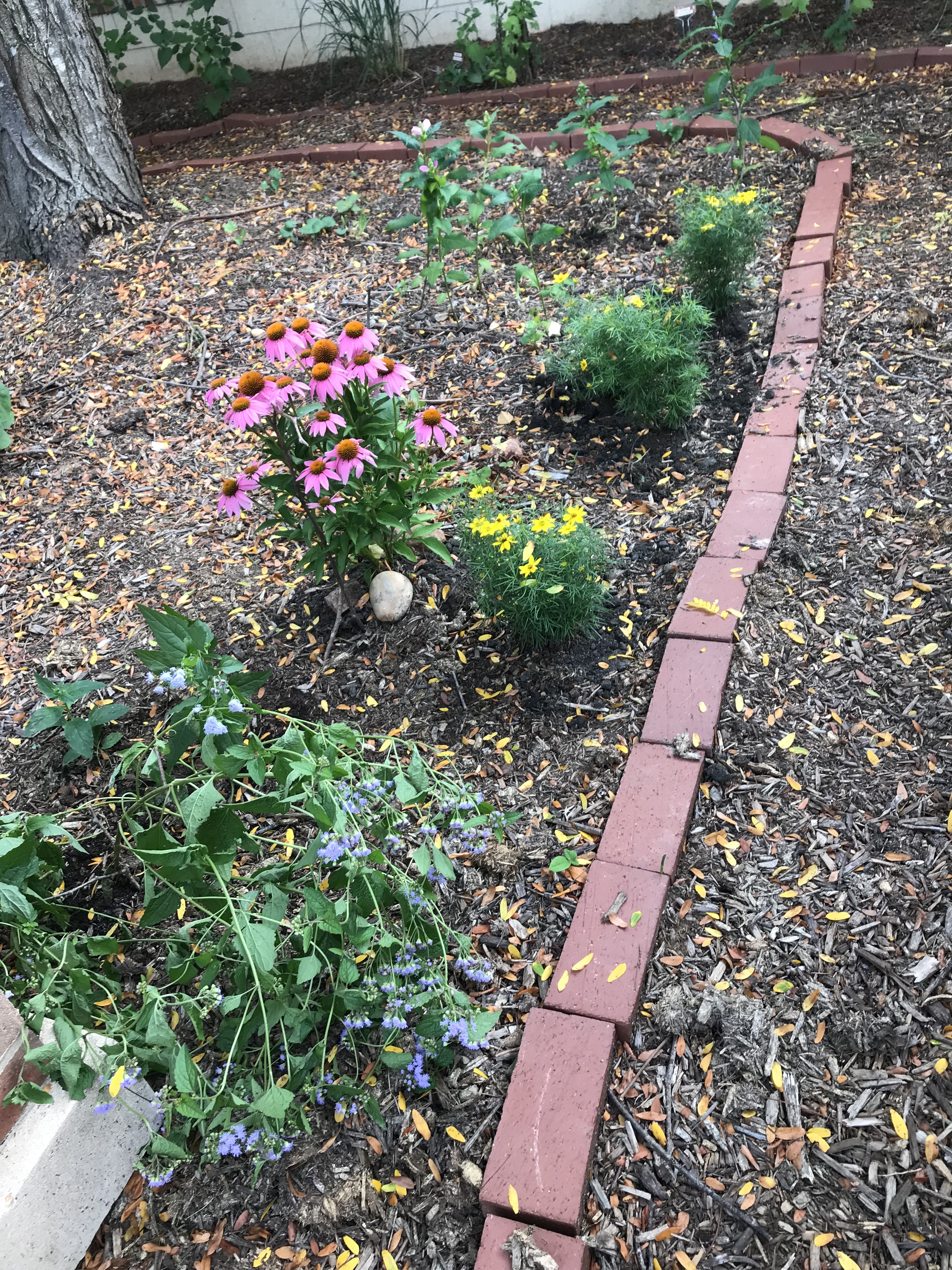
One of the results of stepping out into the unknown is that we learn things. When we were planning the garden, we determined that the space could be described as: Dry shade. However, as the summer progresses, we have discovered that there is much more sun than we realized.
The plants we have just added are all sun tolerant. Reading from front to back in the picture above, they are: mistflower (Conoclinium coelestinum); purple cone flower (Echinacea purpurea); tickseed (Coreopsis verticillata) and great blue lobelia (Lobelia syphilitica).
The flower nearest the back of this picture is a turtlehead (Chelone obliqua). It is not new, but I thought I would mention it, especially since it is starting to flower.
What sun-loving plants do you have in your yard? Tell us about them in the comments.


 Holy Comforter Creation Care